Mission
To promote respect of human rights and the integral socio-economic progress of the Rwandan population, with emphasis on civic participation, access to justice, environmental protection and rural community development, and gender promotion.
Tubibe Amahoro (TA), which means "Sow Peace", works to promote respect for human rights and socio-economic progress in Rwanda.
TA was founded in 2000 in response to the aftermath of the Genocide against the Tutsi. Its 30 founding members shared one objective: to create an organization that would promote sustainable peace through dialogue, mediation, training and improved livelihoods.
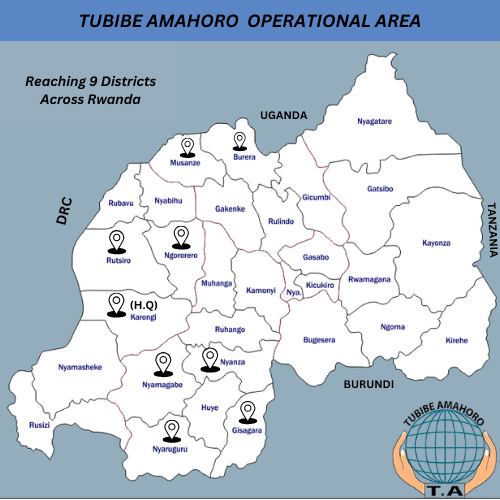
Since then, TA has grown from a small community association into an organization active in 9 districts, with 8 field offices, 33 staff and more than 1,500 community volunteers.
To promote respect of human rights and the integral socio-economic progress of the Rwandan population, with emphasis on civic participation, access to justice, environmental protection and rural community development, and gender promotion.
A society of equity in which laws and human rights are respected by everyone.
TA is a non-governmental, non-discriminatory organization committed to the values of peace, solidarity, liberty, equality and human dignity.
TA follows a human rights-based approach (HRBA): all forms of discrimination in the realization of rights must be prohibited, prevented and eliminated, and priority goes to people in the most marginalized or vulnerable situations, who face the biggest barriers to realizing their rights. TA advocates for participation, accountability, non-discrimination and equality, empowerment and legality between rights holders and duty bearers.
TA helps citizens to self-organize and to build the skills they need to engage effectively in national and local policy formulation and implementation, so that policies deliver better services, especially for poor Rwandans.
Citizen influence on decision-making does not happen automatically. It takes regular advocacy towards those who hold decision-making power, work in coalition with other organizations, and citizens empowered to stand up for social accountability.
TA engages decentralized government entities to prevent and respond to gender-based violence in a timely way, to speed up referrals and services for GBV survivors, and to consider environmental impact and rural socio-economic needs in every planning and budgeting process.
TA is active in nine districts across three provinces.